THE TROUBLE WITH BEING STOOPID IN KENYA
.....In An Industry That Isn't Any Smarter.
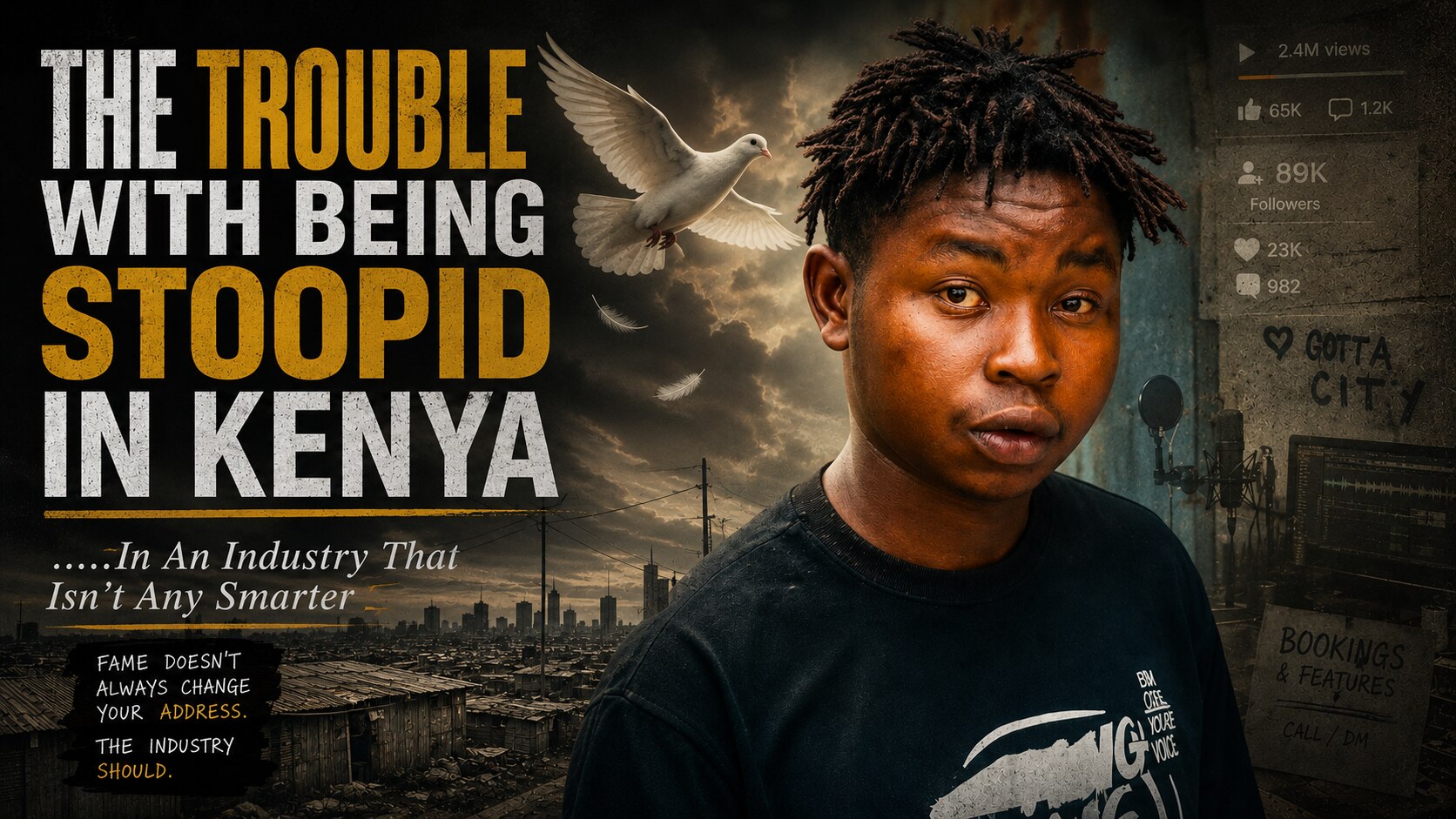
There is something deeply uncomfortable about mourning Stoopid Boy. Not because he did not deserve to be mourned. He did. But because so much of his struggle happened in public. We watched him become famous. We watched him become broke. We watched him drink. We watched him go to rehab. We watched him try to put his life back together. We watched him become content. We watched him try to make music again. We watched. And now he is dead. Stoopid Boy, real name Edgar Waititu, died on Thursday, August 27, 2026. The circumstances of his death had not been officially established at the time of writing, although people close to him have described it as suspected suicide. Whatever the final official account tells us, the story of Stoopid Boy did not begin yesterday. It began in Gotta City. And, perhaps more importantly, it began long before most of Kenya knew his name.
Before the 'G Bag'
Stoopid Boy was part of a generation of Nairobi street artists who did not wait for the traditional music industry to discover them. They built their own audiences from estates, informal settlements, neighbourhood studios, WhatsApp groups, TikTok feeds and the streets themselves. He was associated with Gotta City and had been making music years before his big break. His rise was therefore not a random overnight success story. It was the result of years of participation in the street-music ecosystem. Then came G Baga Jat, better known to Kenyans as G Bag Na Jug. And suddenly, everybody knew Stoopid Boy. The song arrived at precisely the right moment. Kenyan urban music was going through another evolution, with Arbantone becoming one of the country's most visible youth-driven sounds. Stoopid Boy's delivery, humour, Sheng and unmistakably local personality fit the moment perfectly. The record became a breakout, and an official remix brought together Mejja, Breeder LW, Gody Tennor and Spoiler. For a brief moment, this looked like the beginning of the familiar Kenyan success story. Young guy from the hood. Hits. Famous people on the remix. Millions of views. National recognition. Surely the money follows. Except it didn't. Not in the way we like to imagine it does.
Famous, but still in Gotta City
One of the most revealing things Stoopid Boy did after becoming famous was to show people where he actually lived. Through Life After Fame, he documented life in Gotta City and allowed audiences to see the conditions in which he and other residents lived. The point was almost absurd in its simplicity: this man had become famous, but fame had not magically transported him into another socioeconomic class. That should have been one of the great warning signs. Not because every successful artist has to leave the neighbourhood they came from. Many don't. The problem is the assumption that visibility equals stability. Stoopid Boy had cultural currency. He had attention. He had recognition. What he did not appear to have was the institutional infrastructure that converts those things into a durable life. That distinction is at the heart of his story. We are very good at celebrating the moment someone blows up. We are considerably less interested in what happens six months later.
The economics of going viral
There is a dangerous mythology around African entertainment that goes something like this: You make a hit. The hit gets millions of views. Brands notice. Bookings come. Money comes. Your life changes. End of story. Except artists are not YouTube view counters. The money generated around an artist's visibility has to move through managers, promoters, distributors, labels, publishers, streaming platforms, media, advertisers and sometimes simply the chaos of informal business. An artist can therefore become extraordinarily famous without becoming extraordinarily wealthy. Stoopid Boy's life became a particularly brutal illustration of this. In 2024, while the country was embracing G Bag Na Jug, he was also publicly talking about his financial difficulties and his continuing struggles at home. He gave audiences a front-row seat to the strange contradiction of being known everywhere and secure almost nowhere. This is where we should stop asking whether he "managed his fame properly" and begin asking a more useful question. What systems did he have to help him manage it? Because fame is a psychological event as much as it is an economic one. One day, you are nobody. The next, strangers know your face, your slang, your relationships, your home, your friends and your problems. And the internet never gives you a manual.
Then came the drinking
Stoopid Boy eventually spoke publicly about his struggle with alcohol and substance use. In January 2025, he appeared on Oga Obinna's platform and acknowledged that drinking had become a problem. The conversation led to efforts to get him into rehabilitation, and Obinna and other well-wishers helped him enter a three-month programme. There was something encouraging about the story. He went to rehab. He reportedly gained weight. He continued making music. He spoke about changing his life. There was a sense that perhaps the worst was behind him. But rehabilitation is treatment, not magic. And sobriety does not exist in a vacuum. When Stoopid Boy returned, he reportedly struggled with the transition back to his old environment. He spoke of isolation, paranoia and depression. He eventually relapsed. There were public disagreements with people who had tried to help him, and at one point he considered leaving music to concentrate on content creation. That part of the story should make us pause. Because Kenya often treats rehabilitation as the end of the problem. For many people, it is the beginning of a much harder one. How do you go back? How do you rebuild your relationships? How do you earn? How do you deal with the same triggers? How do you cope with the shame of relapse? How do you live with the fact that hundreds of thousands of people now know your worst moments? And what happens when the people who helped you get into rehab cannot stay beside you indefinitely? These aren't celebrity questions. They're human ones.
He was trying to start again
There are details from the final chapter of Stoopid Boy's life that make his death particularly difficult to process. He was still trying. According to his friend Raveen Domi, Stoopid Boy was working on music shortly before his death. The day before he died, Domi says he appeared to be fine and told him he was going to the studio. They had projects they still intended to complete. In another report, Domi recalled that Stoopid Boy asked him for KSh25 during their last encounter. Twenty-five shillings. That detail has stayed with me, not because KSh25 somehow explains a human life, but because of the brutal contrast. This was a man whose breakout song had become one of the recognizable records of the Arbantone era, whose remix included major names in Kenyan music, whose music had generated millions of views. And near the end of his life, someone remembers him asking for twenty-five shillings. That is not a commentary on his worth. It is a commentary on the distance between fame and security.
And then there was the interview nobody wanted to release
Perhaps the strangest development since his death has been the release of a podcast by 2Mbili. The interview had been recorded around two months earlier but was withheld because of things Stoopid Boy had said during the conversation. According to 2Mbili, Stoopid Boy repeatedly asked him to publish it and asked again as recently as Tuesday, only days before his death. After hearing that he had died, 2Mbili released it, describing it as potentially the last interview Stoopid Boy gave. There is something almost unbearably sad about that. A man was asking to be heard. The interview was sitting there. And only after his death did its existence acquire a different weight. That is precisely how hindsight works. Suddenly every sentence feels like a clue. Every post looks like a warning. Every photograph becomes evidence. Every argument becomes a foreshadowing. We should resist that temptation. Mental-health crises are not detective stories, and a person's death should not become an invitation to retroactively diagnose them from clips on TikTok. But we can learn from the pattern. And there was a pattern.
Kenya has known this conversation for years
This is not the first time the creative industry has had this conversation. In 2019, Headspace 254 held a forum at the Kenya National Theatre specifically addressing suicide and mental health within the creative industry. The discussion included artists and a clinical psychologist, with participants warning that signs of suicidality among young people should not be ignored. Seven years later, we are still having versions of the same conversation. Meanwhile, Kenya's own Ministry of Health has spent years documenting the scale of the country's mental health problem. The 2020 Mental Health Taskforce described Kenya as carrying a high burden of mental illness with major gaps in access to care. The Ministry said common mental disorders were estimated to affect roughly one in ten Kenyans, with depression and anxiety prominent and substance-use disorders also a major concern. It specifically identified alcohol as a substantial contributor to substance-use-related illness, with particularly high prevalence among 18–29-year-olds. Kenya now also has a National Baseline Mental Health Survey published by the Ministry of Health in 2025; an acknowledgement that the country needs better data to understand the scale and nature of the problem. So this isn't a case of nobody knowing. We know. We have known for years. The problem is what happens after we know.
Entertainers are particularly vulnerable
There is a strange cruelty built into being an entertainer. You are paid to project something. Confidence. Joy. Sex appeal. Swagger. Happiness. Chaos. Vulnerability. Authenticity. Whatever the audience wants. The performance becomes the product. And sometimes the person disappears behind it. The comedian has to be funny even when he is exhausted. The musician has to perform even when his personal life is collapsing. The influencer has to keep posting when she would rather disappear. The DJ has to keep the party going while dealing with problems nobody in the room knows about. The artist whose brand is built around being wild can find it almost impossible to tell people that the wildness has stopped being fun. And the public has a dangerous tendency to reward dysfunction until dysfunction becomes inconvenient. We call someone "real" when they are visibly unraveling. We turn breakdowns into clips. We comment on intoxicated interviews. We circulate private arguments. We laugh at the artist behaving badly. Then, when the person finally dies, we ask why nobody helped. That is not entirely fair to the public, because no individual fan can be made responsible for saving somebody they do not know. But an industry can be held responsible for the systems it chooses not to build.
The industry knows how to book an artist. Does it know how to look after one?
This is the question I think Stoopid Boy's death leaves hanging over Kenyan entertainment. When an artist signs with a manager, what happens when the manager notices serious substance abuse? When an artist becomes commercially successful, who helps them manage the money? When a young performer suddenly acquires hundreds of thousands of followers, who prepares them for the psychological consequences of sudden public visibility? When an artist goes to rehab, who helps with reintegration? Who helps rebuild a career after relapse? Who helps their family? Who provides confidential counselling? Who trains managers to recognise a mental-health crisis? Who knows what to do when an artist says they want to kill themselves? And, perhaps most importantly, who is responsible when everybody assumes someone else is handling it? The answer in too many cases is nobody. A friend steps in. A celebrity launches a fundraiser. A podcast host offers advice. A church offers prayer. A rehabilitation centre does what it can. A manager tries. The family carries what it can. And the internet watches. That's not a mental health system. It is improvisation.
We shouldn't romanticise the tragedy
There is another trap we need to avoid. Stoopid Boy should not become a posthumous symbol of the tortured genius. We should not turn addiction into artistic authenticity. We should not make suicide seem poetic. We should not pretend that poverty makes someone more creative or that suffering is somehow a necessary ingredient of a great artist. And we certainly should not reduce his life to his darkest moments. Stoopid Boy was more than his addiction. More than his relationship problems. More than the interviews. More than the memes. More than his death. He was an artist. He made people laugh. He made music that connected. He represented a particular Nairobi. And for a brief but meaningful period, he was one of the faces of a new Kenyan sound. Breeder's decision to perform G Bag Na Jug on the night news of his death emerged was, in that sense, fitting. The song that made Stoopid Boy famous was still capable of filling a room after he was gone. That's legacy. But legacy should not be the only thing we leave behind.
Maybe Stoopid Boy's greatest lesson isn't about music
It is about what happens when we confuse being seen with being okay. Those are not the same thing. Stoopid Boy was seen. Very much so. His face was seen. His neighbourhood was seen. His problems were seen. His drinking was seen. His rehab was seen. His arguments were seen. His attempts to return to music were seen. His content was seen. And yet seeing someone is not the same as seeing them. That distinction matters. Because we have built an entertainment culture in Kenya where attention is abundant and care is scarce. There are cameras everywhere. There are microphones everywhere. There are podcasts everywhere. There are platforms everywhere. There are views everywhere. But where are the support systems? Where are the professionals? Where are the structures? Where are the safeguards? Where is the aftercare?
The trouble with being Stoopid
Perhaps that is the cruel irony of Stoopid Boy's name. He wasn't stupid. He was an entertainer who emerged from an environment that did not necessarily give him every tool required to navigate sudden fame. He was talented enough to become famous. But fame is not an education. A viral hit doesn't teach you financial management. A remix with established stars doesn't teach you emotional regulation. Millions of views don't teach you how to recover from addiction. A microphone doesn't give you a support network. And being loved by an audience does not necessarily mean you know how to love yourself. The industry around Stoopid Boy was not entirely indifferent. There were people who tried to help him. Oga Obinna did. Other friends did. People got him into rehab. There were efforts to help him pursue education and build skills outside music. There were people who continued to work with him and believe in another chapter. That matters. The lesson, therefore, isn't that nobody cared. The lesson is that individual care is not enough. Because no matter how good the individual intentions are, eventually somebody has to build the system.
We need an entertainment industry that takes care of entertainers
Kenya's creative economy is getting bigger. Our artists are becoming more influential. Our music is travelling further. Our creators are building audiences that would have been unimaginable twenty years ago. The business is becoming more sophisticated. So our approach to the humans inside the business needs to become more sophisticated too. Mental-health support should not be something an artist encounters only after a breakdown. It should be part of artist development. Managers should know the warning signs. Labels should have access to professional counselling. Major promoters and entertainment companies should know how to respond to a mental-health crisis. Rehabilitation should be followed by reintegration, not simply discharge. Young artists should be taught financial literacy alongside songwriting and performance. And perhaps most importantly, we need to stop treating vulnerability as weakness. The Ministry of Health has already acknowledged the country's enormous treatment gap and the stigma surrounding mental illness. The entertainment industry cannot fix Kenya's entire mental-health crisis. But it can decide whether the people inside it are going to be left to deal with that crisis alone.
Stoopid Boy wasn't supposed to be the warning.
He was supposed to be the beginning. The beginning of a bigger career. More records. More jokes. More G Bag Na Jugs. More strange interviews. More ridiculous stories. More music from Gotta City. More life. Instead, we are writing his obituary. And the easiest thing to do now is to say rest in peace and move on. We probably will. The algorithm will find another artist. Another song will go viral. Another young entertainer will become famous overnight. Another kid from another estate will discover that the internet can make him famous before it makes him financially secure. And when the next one starts struggling, we will probably call him difficult. Unprofessional. Addicted. Crazy. Stoopid. Until, once again, we discover that the person behind the entertainment was human after all. That is the part we should not accept. Stoopid Boy gave Kenya a hit. He gave us laughter. He gave us a piece of Gotta City. And he gave us, whether he intended to or not, a very uncomfortable question. Can an entertainment industry that knows how to make an artist famous also learn how to keep that artist alive? Because the next Stoopid Boy is already somewhere in Kenya. And he might be making us laugh right now.
No corrections have been issued on this story. When we get something wrong we say so here, with the date and what changed. Read our editorial standards.