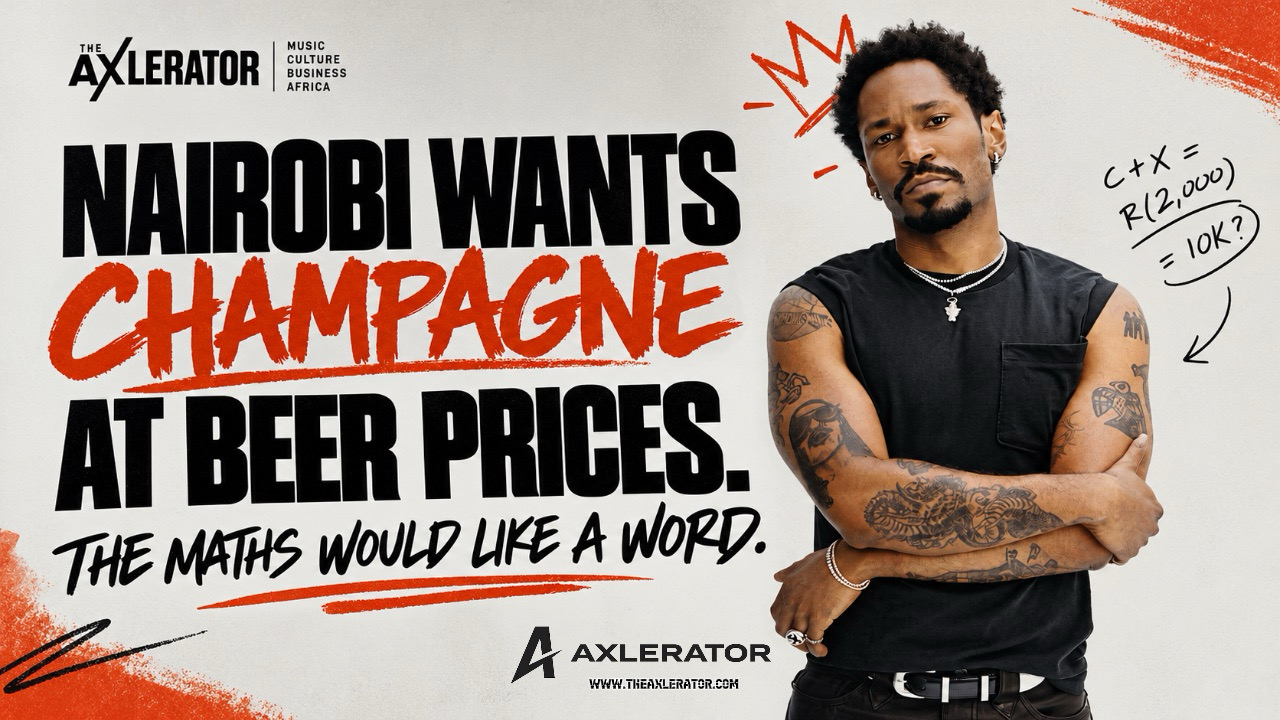
Nairobi wants champagne at beer prices. the maths would like a word.
Nairobians want the biggest artists, the biggest production, the best sound, the best venues and, preferably........ a ticket that costs about the same as lunch
Then comes the inevitable question for promoters:
“But will Nairobi actually fill the venue?”
Fair question.
Especially when the venue holds 2,000 people.
But there is another question worth asking:
What if 2,000 people is exactly the point?
Because somewhere along the way, Nairobi got very comfortable with the idea that an international artist needs to play to 5,000, 8,000, 10,000 or 15,000 people for the show to make sense.
Bigger venue. Bigger crowd. Cheaper ticket.
Simple.
Except it isn’t quite that simple.
Let’s do some very basic mathematics.
Imagine an artist like Kaytranada plays a 2,000 capacity venue in Nairobi.
At KES 10,000 a ticket, that’s:
2,000 × KES 10,000 = KES 20 million (USD 153,000)
Now, before anyone starts calculating the promoter’s imaginary profit margin, let’s remember what actually goes into putting an international artist on a stage.
There is the artist fee. A quick google search of 'how much does kaytranada make per show?' will show you the price range.
Flights. - From Toronto or wherever in the world he is for him and his team of atleast 6. If you dare go to an airline partner, you will probably get 'Who is Kaytranada' from the marketing team. So promoter, prepare to foot that bill.
Accommodation. - For all 6. Hotel partnerships are possible but not a guarantee. And lets not forget, 5 star minimum.
Ground transport. - Maybe Kenyan Prince can donate his Lamborghini Urus if not, luxury cars have to be sourced and paid for......PER DAY that the artist is in town.
Venue hire. - Varies for different venues.
Sound. - Homeboyz need to be paid
Lighting. - Xpose need to be paid
Production. - The promoters team needs to be paid
Security. - Because God forbid your iPhone 18 is stolen at the show.
Subordinate Staff. - Cleaners etc
Marketing - Influencer anataka kulipwa 100 bob per follower....LOL! Watu wa 'I know my worth'
Permits - NEMA, MCSK, KAMP-PRISK, POLICE.
Insurance - An 'In case shit happens' policy is necessary at that level of investment. But if shit doesnt happen, the money doesnt come back.
Hospitality. - Artists have needs. Thats anything from Johnnie Walker Blue to smoked duck to bison and caviar pancakes.
Ticketing. - 5%-10% of ticket revenue kalas!
Taxes. - One of 2 things in life are certain. Death and taxes.
And then there are the approximately 47 things that mysteriously appear between the words “the artist has landed” and “doors are open.” All of a sudden there's a new cmo that was opened and now a new license is needed apparently. Or there's a leak of how much the international artist is being paid so now the local artist wants their money upped.......A lot of strange things happen.
Suddenly that KES 20 million doesn’t sound quite as enormous as it did five seconds ago. Remember, thats at a price point of Kes 10,000 per ticket.
And here’s the interesting bit:
The artist doesn’t become proportionately cheaper because the venue is smaller.
An artist like Kaytranada doesn’t look at a 2,000-capacity room and say:
“Woiye, only 2,000 people? I’ll charge 80% less.”
Unfortunately, international artists have not yet adopted the Kenyan spirit of “tutakusort.”
So the smaller the room, the more important each ticket becomes.
Which is why a KES 10,000 ticket isn’t necessarily outrageous.
It may simply be the mathematics of putting a globally established artist in an intimate room.
But would Nairobi actually pay it? For those that have been to shows in the Western world or even South Africa, you know that's bare minimum pricing for an artist the calibre of a Kaytranada.
This is where it gets interesting.
Because Nairobi has already demonstrated that there is a market for premium experiences.
People will spend KES 10,000 on dinner.
KES 15,000 on a night out.
KES 20,000 on a table.
KES 30,000 on a weekend experience.
And somehow we are expected to believe that spending KES 10,000 to see one of the world’s most respected electronic/dance/hiphop artists in a room with only 2,000 people is where everyone suddenly develops financial discipline.
Please.
We are not a financially disciplined city.
We just become extremely principled when the ticketing link opens.
Maybe we’ve been thinking about concert value incorrectly.
A 2,000-person Kaytranada show isn’t simply a smaller Kaytranada show.
It would be a different product.
There is a huge difference between seeing an artist from the middle of a 4000 - 10,000-person crowd at blankets and being one of 2,000 people in the room.
The intimacy is different.
The energy is different.
The access is different.
The scarcity is different.
And, importantly, the memory is different.
There is something psychologically powerful about being able to say:
“I was there.”
Not:
“I watched the livestream.”
Not:
“I could see the screens.”
But:
“There were 2,000 of us.”
That changes the proposition.
The bigger question is what Nairobi thinks it deserves.
For years, African cities have been expected to prove that they can support global entertainment by producing enormous crowds.
But perhaps the next stage of the market isn’t about enormous crowds.
Perhaps it’s about premium audiences.
A smaller audience paying more.
A better purpose built venue.
Better production.
Better sound.
Better experience.
A globally significant artist.
And fewer people between you and the stage.
That’s not necessarily a worse concert.
In some cases, it might be a much better one.
And this is where an artist like Kaytranada becomes an interesting test.
Kaytranada isn’t an unknown artist being brought into Nairobi and hoping people discover him.
There is already a deeply engaged audience around his music.
There are DJs who play him.
Producers who reference him.
Fans who have followed his work for years.
And a generation of African electronic-music listeners that increasingly sees international electronic music as part of its own cultural vocabulary.
So the question isn’t really:
“Does Nairobi know Kaytranada?”
The more interesting question is:
“Does Nairobi know Kaytranada well enough to pay for him?”
Those are two very different questions.
And if the answer to the second one is yes, the implications go beyond one concert.
It tells promoters, agents and artists that Nairobi can support premium international electronic music at a scale that doesn’t require a stadium or an open field they have to build from scratch.
The reason that matters is because once the market proves it can sell 2,000 tickets at KES 10,000, the conversation changes.
The next artist doesn’t necessarily need 10,000 people.
The next promoter doesn’t necessarily need to chase the biggest available field.
And the audience may discover that scarcity itself has value.
Of course, there is a catch.
A 2,000-capacity room doesn’t give you much room for error.
If you sell 2,000 tickets at KES 10,000, you don’t magically have KES 20 million sitting in the promoter’s bank account.
You have revenue.
Then you have costs.
And then you have the terrifying little word that sits between revenue and profit:
expenses.
So if someone tells you an international concert is 'making millions' because the tickets are KES 10,000, perhaps ask them to show you the spreadsheet before you ask them to show you their Rolex.
The economics of international entertainment are considerably less glamorous than Instagram makes them look.
But there is something exciting about the experiment.
Because if Nairobi can fill a 2,000-capacity room for Kaytranada at a premium price, it demonstrates something important.
Not that Nairobi is rich.
Not that everyone can afford KES 10,000.
And certainly not that every international artist can suddenly charge whatever they want.
It demonstrates something much more useful:
There is a segment of Nairobi’s audience willing to pay a premium for the right artist, the right venue and the right experience.
And that is a very different market from simply asking:
“How cheap can we make the ticket?”
Maybe the future of Nairobi’s concert economy isn’t bigger.
Maybe it’s better.
Maybe 2,000 people is enough.
Maybe KES 10,000 is not an outrageous price for the right experience.
And maybe the real test isn’t whether Nairobi can fill a 2,000-capacity room for an artist of Kaytranada's ilk
Maybe it’s whether Nairobi is finally ready to stop expecting every global experience to come at a local price.
That would be an interesting test.
Just a thought. We hope we've challenged Nairobi promoters to jump to the task.
Ball is in your court.
No corrections have been issued on this story. When we get something wrong we say so here, with the date and what changed. Read our editorial standards.